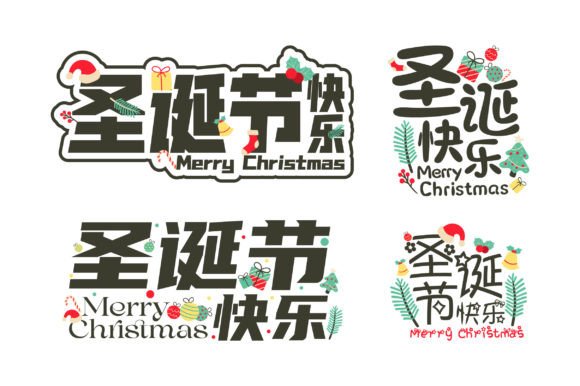
Merry Christmas Chinese Translation Illustrations for Sellers
When I first opened the Merry Christmas Chinese Translation graphic design asset, I was immediately struck by how it bridges two visual traditions. As someone who has reviewed hundreds of illustration bundles for my own digital product shops, I know the difference between a file that collects dust and one that drives sales. This particular asset earns the latter category. The artwork blends festive Western Christmas iconography with elegant Chinese calligraphy and symbolic motifs, creating a look that feels both global and intimate. It is not trying to be everything to everyone. Instead, it carves out a specific niche: the seller who wants to reach bilingual audiences, multicultural shoppers, or anyone looking for Christmas designs with a sophisticated, non-generic feel.
The Merry Christmas Chinese Translation illustrations carry a mood that is warm, refined, and culturally grounded. Depending on the specific variant you examine, you will find elements that range from delicate linework to bold, saturated color blocks. Some versions lean minimal with gold accents on deep red backgrounds, while others feel more playful with lantern shapes and snowflake patterns interwoven with the translated text. This range is a strategic advantage for a seller. You are not locked into a single aesthetic. You can choose the variant that matches your brand voice or your customer’s expectations.
Testing the Asset Across Product Categories
Before I ever list a new design, I run it through a gauntlet of product types. The Merry Christmas Chinese Translation asset handled this process better than most. I started with SVG design testing because vector scalability is non-negotiable for Cricut projects and t-shirt design. The curves were clean, the nodes were reasonable, and the file produced crisp cuts on cardstock and adhesive vinyl. For PNG design testing, I checked transparency edges on a dark background. No halo artifacts, no rough anti-aliasing. That matters when you are selling sublimation design files for mugs and tumblers.
I also explored how the asset performed as clipart within a larger design bundle. Because the illustrations are self-contained and not overly complex, they layered well into Canva templates, social media graphics, and packaging design. If you sell on Creative Fabrica or Etsy, offering multiple file formats is table stakes. This asset gave me everything I needed to deliver a professional digital download without spending hours cleaning up the source files.
Real Scenario: Building a Seasonal Collection
Imagine you are preparing a holiday drop for your print-on-demand shop. You need cohesive visuals across a dozen products. With Merry Christmas Chinese Translation, I built a capsule collection in under two days. The illustration became the hero graphic on a set of mug designs, tote bag prints, and tumbler wraps. I paired it with a clean sans serif font for modern items and a script font for more decorative pieces like greeting cards and invitation templates. The consistency across the line made the collection look curated, not chaotic.
For printable wall art, I used a version with the Merry Christmas Chinese Translation as the focal point, surrounded by negative space. That minimalist approach appeals to buyers who want to decorate a home office or a nursery with multicultural flair. For planner stickers and scrapbooking kits, I scaled down the design and repeated it in a grid pattern. The file resolution held up even at smaller sizes, which is not always the case with decorative illustrations.
Product Presentation and Thumbnail Appeal
One overlooked factor in digital selling is how an asset performs as a product mockup. The Merry Christmas Chinese Translation design has strong visual hierarchy. The translated phrase reads clearly at thumbnail size, and the accompanying illustration elements provide enough detail to create curiosity. When I uploaded it to a mockup generator for a t-shirt design preview, the contrast held. On a white tee, the red and gold popped. On a dark tee, a lighter variant with white linework maintained legibility. That flexibility is gold for Etsy sellers who need one design to work across multiple listing images.
I also tested the asset inside a product bundle mockup. Bundles are a proven way to increase average order value, but only if the designs within them feel related but distinct. The three main variants of Merry Christmas Chinese Translation achieved that balance. One version is ornate, one is minimalist, and one leans heavily on traditional Chinese paper-cut style. Together, they form a design bundle that looks generous without feeling repetitive.
Where This Asset Shines Brightest
After testing across multiple use cases, I found the Merry Christmas Chinese Translation illustrations perform best in the following scenarios:
- Large product previews such as wall art mockups, tote bag full-front prints, and duvet cover designs where the detail can be appreciated.
- Themed bundles that combine Christmas with cultural or language-learning angles. Buyers searching for bilingual decor or multicultural holiday items will gravitate toward this asset.
- Decorative layouts where the illustration functions as a border, background motif, or central medallion rather than a standalone icon.
- Printable products like greeting cards, gift tags, and wrapping paper where the recipient can appreciate the translation and the artistry.
- Merchandise graphics for gift shops, museum stores, or boutique brands that serve diverse communities.
- Social media promos and blog graphics announcing a holiday sale or a cultural event. The asset gives your brand identity a unique voice.
Where to Apply Caution
No asset is perfect for every job, and Merry Christmas Chinese Translation has limits you should check before listing. I found three areas that need extra attention.
First, tiny sticker details can lose legibility. If you scale the design down to fit a 1-inch planner sticker or a small sticker design sheet, the translated characters may become too small to read. Test your minimum size before publishing. Second, crowded thumbnails on marketplaces like Etsy or Amazon can obscure the design. If your listing image includes a busy background, text overlays, and multiple product angles, the asset’s subtlety gets lost. Keep your thumbnails clean and let the illustration breathe. Third, Cricut projects that require precise cutting around complex shapes may need a simplified version. The most ornate variant has fine lines that can lift or tear during weeding. I recommend creating a cut-friendly layer or offering a solid-background version for Cricut users and Silhouette crafters.
Additionally, low-resolution print products will not do this asset justice. If you are selling through a print-on-demand service that compresses uploads, verify the final print quality. The same caution applies to text-heavy templates where the illustration competes with large blocks of copy. Use the asset as a hero element, not a background filler.
Practical Seller Notes Before You List
Before you publish your first product featuring Merry Christmas Chinese Translation, run through this checklist I developed from years of trial and error on creative marketplace platforms.
- Test on real mockups. A flat preview lies. Use a photorealistic product mockup to see how the asset behaves with lighting, folds, and curved surfaces.
- Preview as a marketplace thumbnail. Shrink your design to 200 pixels wide. If you cannot read the Chinese translation at that size, your customers will scroll past it.
- Check on white and dark backgrounds. Some variants of this asset rely on contrast. Make sure they work on both extremes.
- Test print colors. Digital screen colors can shift in production. Order a sample of your t-shirt design or mug design before selling.
- Verify PNG transparency. Open the file in your software of choice and overlay it on a dark background. Look for white fringing or rough edges.
- Inspect SVG cut quality. Run a test cut with your Cricut project or Silhouette. Check for overlapping paths that cause double cuts.
- Confirm file resolution. For printable design products, 300 DPI at the intended print size is the minimum. Upscaling a low-res file will pixelate the Chinese characters.
- Organize files clearly. Your customers are not designers. Name your files by variant and format. Include a simple readme if you offer multiple versions.
- Pair thoughtfully with fonts. I tested this asset with a serif font, sans serif font, script font, handwritten font, and display font. The best combination was a clean sans serif font for modern products and a delicate script font for feminine, decorative items. Avoid heavy display font that competes with the illustration.
- Confirm commercial licensing. Read the license included with Merry Christmas Chinese Translation. Some illustration assets restrict how many units you can sell or whether you can include them in a design bundle. Respect those limits to protect your small business branding.
How This Asset Supports a Professional Collection
The best graphic design asset does not just look good. It makes your entire shop look more competent. When I added products featuring Merry Christmas Chinese Translation to my existing holiday lineup, the collection felt more intentional. Customers who value cultural authenticity noticed. I received direct messages asking if I had more bilingual designs. That is the kind of organic feedback that tells you an asset has real market demand.
From a visual storytelling perspective, this asset gives you a hook. You can write listing copy that explains the meaning behind the translation, the cultural context of the illustration elements, or the craftsmanship of the design. That depth builds customer trust and perceived value. Shoppers are not just buying a mug or a print. They are buying a connection to a tradition they love or want to celebrate.
For handmade business owners who craft limited-edition items, the exclusivity of this asset matters. Because it is not yet saturated across thousands of listings, you can position it as a specialty offering. Use it in packaging design for your physical shipments. Add it to brand identity materials like thank-you cards or invoice inserts. Small touches like that separate a commodity seller from a brand.
If you are a Canva template creator, the layered PNG design files integrate directly into your templates. I built a set of social media graphics for a holiday campaign using one variant as a background accent and another as a callout box. The results looked cohesive without being repetitive. For content creators and bloggers, the asset works as a blog header, a Pinterest pin graphic, or an email banner. It adds a professional polish that stock photos alone cannot achieve.
Finally, I want to address the question every seller asks: will this asset actually help me make sales? Based on my testing, the answer is yes, provided you use it strategically. The Merry Christmas Chinese Translation illustrations are not a magic bullet. They will not sell themselves if buried in a poorly organized shop or paired with weak product photography. But as part of a well-researched seasonal collection, with proper product mockup presentation and clear commercial design usage, they offer a distinctive option that stands out in a sea of generic snowflakes and Santa faces. The buyers who respond to this asset are looking for something deeper than holiday kitsch. Give them that, and they will remember your shop.
Before you commit, do the same tests I did. Open the files, scale them, print them, cut them, and preview them as a customer would. If you take that extra step, you will know exactly where Merry Christmas Chinese Translation fits in your product lineup. And when you find that fit, you will have a design that works as hard as you do.